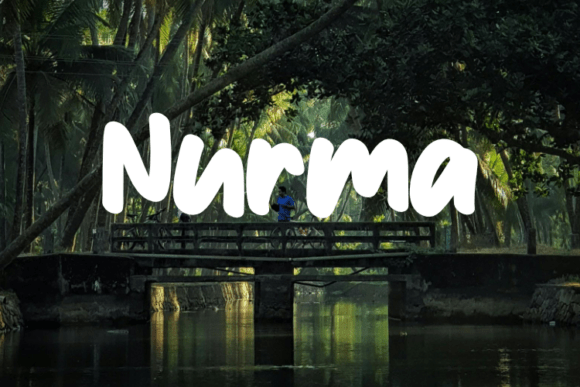
Nurma: A Modern Display Font for Handmade Labels & Printables
As someone who hand-labels small-batch candles, designs wedding welcome signs, and sells printable planner pages on Etsy, I know how much a font can shape a product’s first impression. Nurma isn’t just another pretty typeface—it’s a thoughtful, modern display font built for makers who need elegance *and* reliability. Its clean lines, balanced proportions, and subtle sophistication make it instantly recognizable without sacrificing readability—even at small sizes or on textured kraft paper.
Nurma lives in that sweet spot between contemporary minimalism and quiet warmth. It’s not starkly geometric like many sans serifs, nor overly ornate like vintage scripts. Instead, it carries a gentle rhythm—soft curves meet confident verticals, and letterforms breathe with consistent spacing. That balance is why it works so well across physical and digital craft projects: whether laser-cut onto wooden tags, printed on matte sticker sheets, or embedded in an SVG file for Cricut users, Nurma retains its clarity and charm.
I’ve used Nurma for everything from boutique soap labels (where legibility at 8pt matters) to oversized farmhouse-style wall art (where its graceful presence commands attention). On candle jars, it gives a refined, intentional feel—no more squinting to read ingredients or scent names. For holiday packaging, its clean structure holds up beautifully next to foil-stamped accents or rustic twine. And because it’s delivered as a single .otf OpenType file, I get full access to standard ligatures and stylistic alternates—small touches that elevate a “thank you” tag or wedding menu without extra design work.
Readability is where Nurma truly shines for crafters. Unlike some decorative display fonts that blur when scaled down, Nurma maintains crisp edges even at 6–7pt on product labels or tiny jar stickers. I tested it on my Silhouette Cameo with vinyl—no tracking issues, no cut errors on tight curves. For printed cards and invitations, it renders cleanly on both inkjet and laser printers, and the letterforms hold their shape on textured cardstock. That consistency means fewer mockup revisions and more confidence when uploading listings to Etsy or Shopify.
Think about what your customers see first: a product tag, a digital download cover, a social media graphic announcing your new seasonal collection. Nurma helps communicate quality before a single word is read. When I switched my printable quote art from a generic sans serif to Nurma, my conversion rate on Pinterest pins increased—not because the message changed, but because the typography felt more intentional, more *crafted*. That perceived value translates directly into trust, especially for buyers investing in premium printables or custom stationery.
Nurma excels with short, high-impact text: brand names, greeting card headlines, shop signage, mug quotes, tote bag slogans, and SVG layer titles. It’s not designed for long paragraphs—that’s not its role—but it’s perfect for anything meant to be seen, remembered, and appreciated at a glance. For wedding stationery, I pair Nurma with a delicate script font for names and a neutral sans serif for details—creating hierarchy without visual noise. For product packaging, I often use Nurma for the brand name and a sturdy, highly legible sans serif for ingredients or care instructions. The contrast feels purposeful, not chaotic.
Seasonal crafting is another area where Nurma proves versatile. Its modern elegance reads as timeless—not tied to one trend—so it works equally well for spring botanical labels, autumn harvest tags, winter holiday cards, or summer market banners. Last December, I used it for a set of minimalist gift tags paired with red linen ribbon; the font’s clean weight held up against the texture without competing. In spring, I layered it over watercolor backgrounds for printable planner headers—its open counters kept the text legible even behind soft washes.
Font pairing is intuitive with Nurma. Because it’s a display font with strong personality but restrained flair, it pairs beautifully with expressive handwritten fonts for contrast (think: Nurma for “Wildflower Co.” + a flowing script for “Hand-poured Soy Candles”). It also grounds bolder serif fonts in branding kits or templates—Nurma handles headlines while a classic serif anchors body copy. For digital downloads, I often use Nurma in title slides and section dividers, then switch to a highly readable sans serif for instructions or resource lists. That combination keeps users oriented and engaged.
One practical note: Nurma comes as a single .otf file, which means broad software compatibility—Cricut Design Space, Silhouette Studio, Canva, Adobe Illustrator, Affinity Designer, and even free tools like Inkscape handle it smoothly. No need to juggle multiple files or worry about missing glyphs. And since it’s a commercial font licensed for physical products and digital downloads, I confidently include it in my SVG bundles, editable Canva templates, and printable collections—knowing my buyers can use it for their own small business needs, too.
If you’re building a cohesive brand identity across labels, social posts, packaging, and printables, Nurma delivers consistency without rigidity. It’s the kind of font that makes your “new arrival” banner look polished, your product photo captions feel intentional, and your Etsy listing thumbnails stand out in a crowded feed. It doesn’t shout—but it invites attention, quietly and confidently. And in a handmade marketplace where authenticity and care are currency, that kind of quiet strength is exactly what your products deserve.